
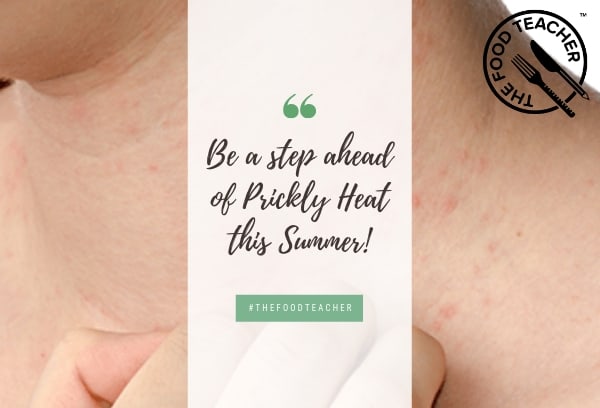
Prickly heat also known as ‘heat rash’ has been known to ruin anyone’s summer holiday regardless of age so putting a few well informed changes in place might make this summer one to remember.
 After several enquiries through The Food Teacher™ Clinic, our sudden change in weather and with imminent trips away to hotter climes on the horizon it’s time to talk Prickly Heat. As a child myself I suffered and have on/off bouts as an adult, which I know for me are exacerbated by sun creams, not drinking enough water and covering up too much. As a registered nutritional therapist I know all to well that when we start talking about looking after the inside to nurture the outside of our bodies we can understand why what we eat and drink can have a huge impact on our skin health.
Prickly heat, known medically as miliaria is a considered a disorder of the eccrine sweat glands [1], which secrete water to the skin surface, where it cools the body by evaporation. For various reasons these can become obstructed usually after excessive exposure to heat, humidity or even hyperthermia resulting in the retention of sweat within the skin [2]. Whilst hunting out research about heat rash not much information has been published in recent years. Interestingly the summer of 1952 with its record increases in temperature and humidity saw an unusual elevation in the condition, which is generally recognised, as a trivial skin condition [3].
This irritating and unsightly condition is very common with up to 30% of people suffering. It typically affects fair-skinned people of any age though it is especially common in children and infants due to their underdeveloped sweat glands [4]. The condition affects both sexes equally and the most common affected sites are the trunk, the upper back and/or the lower back [5]. Worth noting is the potential link to resident skin bacteria, such as Staphylococcus epidermidis and Staphylococcus aureus, which can also play a role in the development of miliaria [6,7].
Symptoms include small red bumps, called papules, which may itch or cause an intense, prickling sensation [8]. Heat rash can be broken down into 3 types with prickly heat being referred to as Miliaria rubra. If the red bumps develop further and become pus-filled the condition is then referred to as miliaria pustulosa [8].
The million dollar question for any sufferer or parent of a child sufferer is can it be alleviated and/or prevented and if so how. Given that it is linked to the body’s natural response to sweat it can often be very difficult to manage but interestingly there are a number of strategies, which have had some success. Have a read of the suggestions below and perhaps try all or a few and keep an eye on symptoms this summer.
 * Food Intolerances [9] – a potential underlying intolerance has been linked to prickly heat and could be worth investigation. It’s commonly been associated with cows milk and dairy products as well as wheat, peanuts, tea and coffee although if prickly heat is intolerance linked the culprit can often be something quite unusual such as orange juice or radishes [9]. We offer Food Intolerance testing at The Food Teacher™ Clinic and offer a free phone chat to anyone who is considering nutritional therapy and testing.
 * Switch your Sun Cream [9] – Heat rashes can in fact be linked to a reaction to the fragrances and chemicals in our sun creams or even blockage of the glands. Sun creams play an important role with regard to our skin health but opting for a natural mineral based cream can make a real difference. Brands I have used in the past and recommend include Green People, Neal’s Yard or Badger. You might want to take advantage of our new ‘Family Sunscreen Bundle’ from the Food Teacher Shop, which includes a Green People adult and child sun cream and aftersun. Otherwise order direct from The Natural Dispensary (call: 01453 757792) and quote TFT010 for 10% discount.
* Are you eating enough fish? [9] – The omega-3 fats found in oily fish help protect against free radical damage in the skin from the sun. If you are taking sufficient amounts these fats help to reduce the burning of the skin and development of prickly heat. Good sources of oily fish include…. If you don’t like oily fish or don’t consume it at least 3 times a week then consider a supplement such as Eskimo Brainsharp or Biocare Mega EPA Forte. These can also be ordered directly from The Natural Dispensary (call: 01453 757792) and quote TFT010 for 10% discount.
* Focus on skin nourishment [9] – Some foods are rich in nutrients that support and nourish the skin from the inside out. These skin-nourishing foods include apples, carrots, spinach (best raw), watercress, broccoli, pumpkin, cantaloupe melons, apricots, mango, papaya and figs. Artichokes, beetroot and asparagus are also beneficial foods as these cleanse the liver, which in turn aids skin healing.
* Vitamin C and Vitamin E [10]- Taking vitamin C (2g daily) combined with vitamin E (1000iu daily) for at least 10 days before traveling to a tropical climate or when expecting a sudden change in weather conditions may help prevent damage from sun exposure. Vitamin C also acts like a natural anti-histamine [11] so can help to manage or reduce the reaction to heat.
 * B Vitamins – Consume vitamin B-6. Heat rash is a response of your body’s immune system. Keeping your immune system healthy helps it fight any infection or inflammation caused from excessive sun exposure. The recommended daily allowance (RDA) of vitamin B6 in the UK is 1.4mg a day for men and 1.2mg a day for women. The best way to consume enough vitamin B-6 is by eating food sources including fish, carrots, bananas, chicken breasts and spinach.
* Prevention [9]
- Avoid blocking the pores with insect repellent.
- Avoid situations that can lead to excessive sweating, such as hot and humid environments and strenuous exercise.
- Cover up with loose fitting natural clothing, such as cotton, to allow the skin the breathe.
- Use a skin brush regularly to remove dead skin cells and enable the pores to work correctly.
- Take regular cool showers and allow the skin to dry naturally.
- Be aware that strong antibiotics and some drugs can make the skin sun-sensitive. If you are taking them stay out of the sun.
- If prickly heat does not clear after 4-5 days and an infection sets in, you must see a doctor.
- What works for you? Have you found a solution to your prickly heat that others may benefit from hearing about? Does t involve nutrition, skin products or lifestyle changes? Please do share in the comments below and something that works for you may be the answer someone else is looking for.

We hope this article may serve useful for you and your family this summer.
For further nutrition advice and support contact info@thefoodteacher.co.uk to book a free telephone chat to discuss how we might be able to help you.
References:
Ghahramani G. (2018) Miliaria. In: Rosenbach M., Wanat K., Micheletti R., Taylor L. (eds) Inpatient Dermatology. Springer, Cham.
Leow, M.Q.H. and Chong, W.S., 2015. Care of patients with miliaria profunda: patient education and management. Dermatological Nursing, 14(1), pp.32-34.
LUBOWE, I.I. and PERLMAN, H.H., 1954. Periporitis staphylogenes and other complications of miliaria in infants and children. AMA archives of dermatology and syphilology, 69(5), pp.543-553.
Shi, W., 2016. Composition for prevention and treatment of miliaria. U.S. Patent Application 14/486,048.
Bukhari, I., Alayoubi, A. and Alzahrani, M., 2016. Miliaria pustulosa misdiagnosed as a case of acne vulgaris. Our Dermatology Online, 7(4), p.448.
Holzle E, Kligman AM. The pathogenesis of miliaria rubra. Role of the resident microflora. Br J Dermatol. 1978;99:117-37.
Mowad CM, McGinley KJ, Foglia A, Leyden JJ. The role of extracellular polysaccharide substance produced by Staphylococcus epidermidis in miliaria. J Am Acad Dermatol. 1995;33:729-33.
University of Illinois-Chicago, S. (2019). Heat rash: Symptoms, appearance, and causes. [online] Medical News Today. Available at: https://www.medicalnewstoday.com/articles/181512.php [Accessed 3 Jul. 2019].
Courteney, H., 2011. 500 of the Most Important Health Tips You’ll Ever Need. 4th ed. United Kingdom: CICO Books.
Eberlein-König, B., Placzek, M. and Przybilla, B., 1998. Protective effect against sunburn of combined systemic ascorbic acid (vitamin C) and d-α-tocopherol (vitamin E). Journal of the American Academy of Dermatology, 38(1), pp.45-48.
Johnston, C.S., 1996. The antihistamine action of ascorbic acid. In Subcellular Biochemistry (pp. 189-213). Springer, Boston, MA.


